
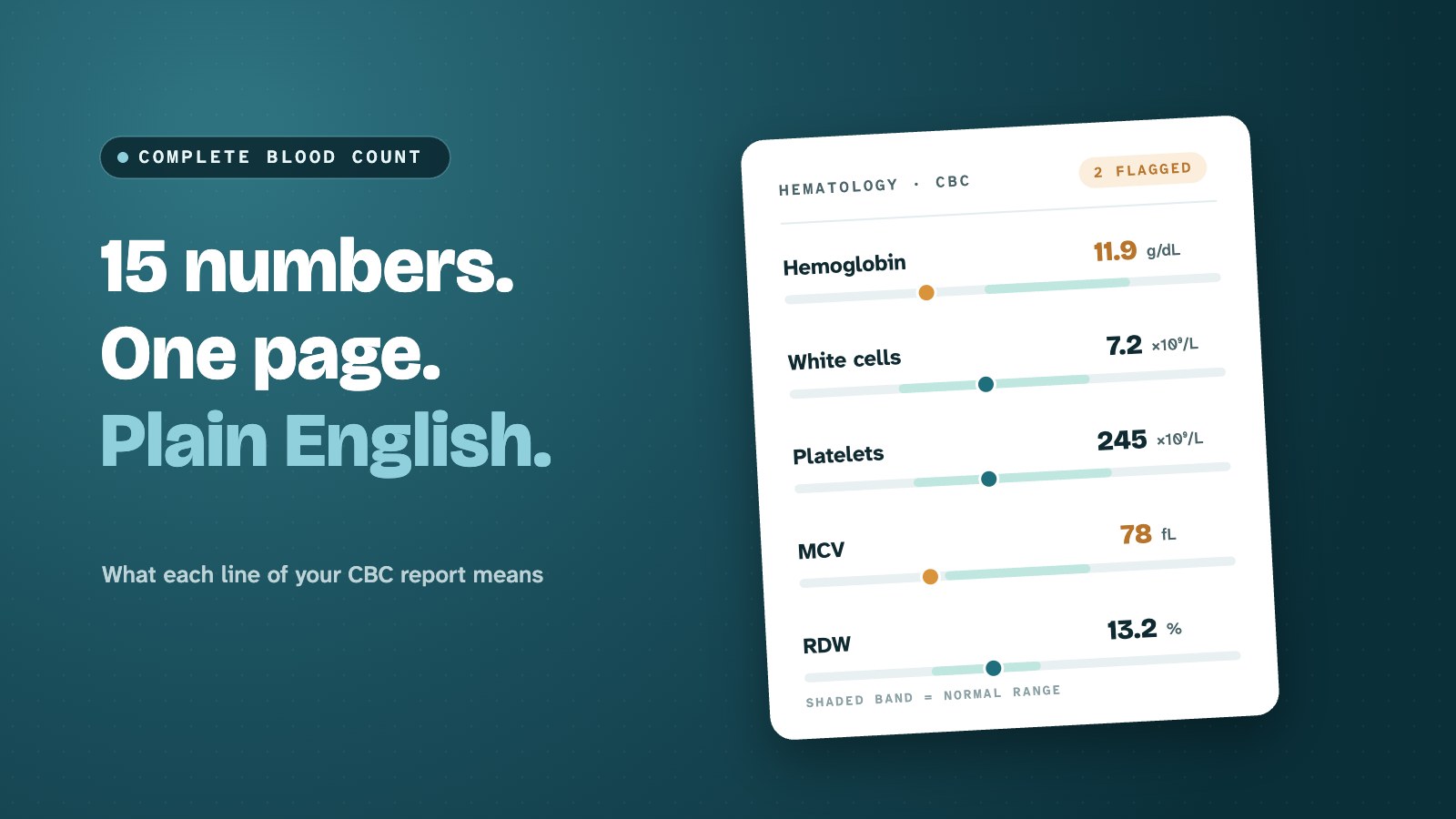
A complete blood count (CBC), called a full blood count (FBC) in the UK, is one of the most common blood tests in the world. Doctors order it at annual physicals, before surgery, when you feel unusually tired, and to follow many long-term conditions. The report has 15 to 20 lines of numbers and abbreviations like Hb, WBC, MCV and Hct, and it’s easy to worry when one of them is flagged “H” or “L”.
This guide explains each part of a CBC report in plain English, gives typical normal ranges for adults in both US and UK/Canadian units, and tells you which results deserve a call to your doctor.
Important: reference ranges differ slightly between labs. Always compare your result with the range printed next to it on your own report. A value just outside the range is often not a problem; your doctor reads the whole report together with your symptoms and history.
What a CBC measures
A CBC looks at the three kinds of cells in your blood:
- Red blood cells (RBCs) carry oxygen. Hemoglobin, RBC count, hematocrit and the “indices” (MCV, MCH, MCHC, RDW) describe them.
- White blood cells (WBCs) fight infection. The total WBC count and the differential (the share of each type) describe them.
- Platelets help your blood clot.
You don’t need to fast for a CBC unless other tests, such as fasting glucose or a lipid panel, are being drawn at the same time.
CBC normal range chart for adults
| Test | US units | UK / Canada (SI units) |
|---|---|---|
| Hemoglobin (Hb), men | 13.5 to 17.5 g/dL | 135 to 175 g/L |
| Hemoglobin (Hb), women | 12.0 to 15.5 g/dL | 120 to 155 g/L |
| Hematocrit (Hct), men | 41 to 50% | 0.41 to 0.50 L/L |
| Hematocrit (Hct), women | 36 to 44% | 0.36 to 0.44 L/L |
| RBC count, men | 4.5 to 5.9 million/µL | 4.5 to 5.9 × 10¹²/L |
| RBC count, women | 4.1 to 5.1 million/µL | 4.1 to 5.1 × 10¹²/L |
| MCV | 80 to 100 fL | |
| MCH | 27 to 33 pg | |
| MCHC | 32 to 36 g/dL | 320 to 360 g/L |
| RDW | 11.5 to 14.5% | |
| White blood cells (WBC) | 4,000 to 11,000 /µL | 4.0 to 11.0 × 10⁹/L |
| Neutrophils | 40 to 70% (about 2.0 to 7.5 × 10⁹/L) | |
| Lymphocytes | 20 to 40% (about 1.0 to 4.0 × 10⁹/L) | |
| Monocytes | 2 to 10% | |
| Eosinophils | 1 to 6% | |
| Basophils | 0 to 2% | |
| Platelets | 150,000 to 400,000 /µL | 150 to 400 × 109/L |
| ESR | Roughly up to 15 mm/hr in men and 20 mm/hr in women; rises with age | |
These are typical adult values. Children, pregnant women and people living at high altitude have different ranges.
Hemoglobin: the line everyone checks first
Hemoglobin is the protein in red cells that carries oxygen. Low hemoglobin is called anemia. It’s especially common in women of childbearing age, older adults and people with long-term illness.
- Low hemoglobin can cause tiredness, shortness of breath on stairs, pale skin, headaches and dizziness. Common causes include iron deficiency, heavy periods, vitamin B12 or folate deficiency, blood loss from the gut, kidney disease and chronic inflammation.
- High hemoglobin is less common. It can be seen in smokers, people who are dehydrated, people living at altitude, those on testosterone, and in some lung, heart or bone-marrow conditions.
MCV, MCH and MCHC: what kind of anemia?
These red cell indices describe the size and color of your red cells, which points your doctor towards the cause of anemia.
- Low MCV and MCH (small, pale cells) are typical of iron deficiency. Thalassemia trait can look similar, so your doctor may order iron studies (ferritin) or a hemoglobin electrophoresis.
- High MCV (large cells) is often seen with vitamin B12 or folate deficiency, regular alcohol use, an underactive thyroid, liver disease and some medicines, including metformin over the long term (through low B12).
- High RDW means your red cells vary a lot in size. It often rises early in iron deficiency.
White blood cell count: infection and immunity
- High WBC (leukocytosis) is most often due to a bacterial infection. Stress, steroid medicines, smoking, pregnancy and, rarely, blood cancers can also raise it.
- Low WBC (leukopenia) is common during and after viral infections, and can be caused by some medicines, autoimmune conditions and bone-marrow problems.
- High neutrophils usually point to a bacterial infection or inflammation.
- High lymphocytes are common in viral infections.
- High eosinophils are often seen with allergies, asthma, eczema and some parasitic infections.
Platelet count
Platelets help stop bleeding. A low count is called thrombocytopenia; a high count is thrombocytosis.
- Low platelets can follow viral infections, and can be caused by some medicines (including heparin), heavy alcohol use, liver disease, autoimmune conditions and bone-marrow problems.
- High platelets often follow infection, inflammation, iron deficiency, surgery or removal of the spleen.
Sometimes platelets clump in the sample tube and the analyzer reports a falsely low count. If you feel well and the result is unexpected, your doctor may simply repeat the test.
ESR: a general sign of inflammation
ESR (erythrocyte sedimentation rate) is often run alongside the CBC. A raised ESR is a non-specific sign of inflammation or infection. It rises with age, in women, in pregnancy and with anemia, so on its own it doesn’t point to one disease. Many doctors use CRP (C-reactive protein) as well.
When to contact your doctor promptly
- Hemoglobin below about 8 g/dL (80 g/L), or a sudden drop from your previous result
- Platelets below about 50,000/µL (50 × 109/L)
- Bleeding gums or nosebleeds that won’t stop, black or bloody stools, blood in your urine, or tiny red or purple spots on the skin
- Very high or very low white cell counts, or a report that mentions “abnormal cells” or “blasts”
- Fever with a low white count, especially if you’re on chemotherapy
For chest pain, severe shortness of breath, fainting or heavy bleeding, call 911 (US and Canada), 999 (UK) or your local emergency number.
Compare your CBC over time, not just once
One report is a snapshot. What usually matters more is the trend: is your hemoglobin slowly drifting down, or are your platelets recovering after an infection? Keeping every report in one place makes this easy to see, and gives your doctor the full picture at your next visit.
Read your CBC report with Curevity
With the free Curevity app for iPhone and Android, you can take a photo of your lab report or upload the PDF. The lab report scanner runs on your phone and organizes each value with its unit and reference range, and flags anything out of range for your doctor to review. You can then ask the Curevity AI health assistant questions like “Explain my latest report” or “Compare my hemoglobin with last time”, and share the report with a family member.
Curevity is a support tool, not a doctor, and it doesn’t diagnose. It helps you understand your numbers and prepare good questions for your appointment.
Frequently asked questions
Do I need to fast for a CBC?
No. A CBC can be done at any time of day without fasting, unless your doctor has also ordered tests like fasting glucose or a lipid panel from the same blood draw.
What is a normal hemoglobin level for women?
For most adult women, about 12.0 to 15.5 g/dL (120 to 155 g/L). During pregnancy, doctors use slightly different cut-offs.
What is the difference between a CBC and an FBC?
They’re the same test. “CBC” is used in the US and Canada; “FBC” (full blood count) is the usual term in the UK.
Can I raise my hemoglobin with food?
If the cause is iron deficiency, iron-rich foods such as red meat, poultry, fish, beans, lentils, tofu, spinach and fortified cereals help, especially with vitamin C from citrus fruit or peppers. Many people also need an iron supplement, so ask your doctor to check the cause first.
This article is for general information and does not replace medical advice. Always discuss your results with your doctor.