
Kidney function tests check how well your kidneys filter waste from your blood. In the US they’re part of the basic or comprehensive metabolic panel (BMP or CMP); in the UK they’re usually called U&Es (urea and electrolytes) with an eGFR. Diabetes and high blood pressure are the two leading causes of chronic kidney disease, so anyone with either condition is usually tested at least once a year.
Early kidney disease is silent. You can feel completely well while kidney function slowly declines, which is why these numbers matter. This guide explains each value, with typical adult ranges in both US and UK/Canadian units.
Important: ranges vary by lab, age, sex and muscle mass. Compare your result with the range printed on your report, and let your doctor interpret it with your history.
Kidney function test normal range chart (adults)
| Test | US units | UK / Canada (SI units) |
|---|---|---|
| Creatinine, men | About 0.7 to 1.3 mg/dL | About 60 to 110 µmol/L |
| Creatinine, women | About 0.5 to 1.1 mg/dL | About 45 to 90 µmol/L |
| BUN (blood urea nitrogen) | About 7 to 20 mg/dL | Urea about 2.5 to 7.8 mmol/L |
| eGFR | 90 or above mL/min/1.73m² is normal; 60 to 89 can be normal for older adults | |
| Uric acid, men | About 3.4 to 7.0 mg/dL | About 200 to 420 µmol/L |
| Uric acid, women | About 2.4 to 6.0 mg/dL | About 140 to 360 µmol/L |
| Sodium | About 135 to 145 mmol/L (mEq/L) | |
| Potassium | About 3.5 to 5.0 mmol/L (mEq/L) | |
| Urine albumin-to-creatinine ratio (ACR) | Below 30 mg/g | Below 3 mg/mmol |
Creatinine: the key number
Creatinine is a waste product from your muscles. Healthy kidneys clear it, so when kidney function falls, creatinine in the blood rises. Muscular people can have a slightly higher creatinine and older or very slim people a lower one, which is why doctors rely on eGFR as well.
Creatinine can also rise temporarily with dehydration, a large meat meal, intense exercise, creatine supplements and some medicines.
eGFR: how well your kidneys filter
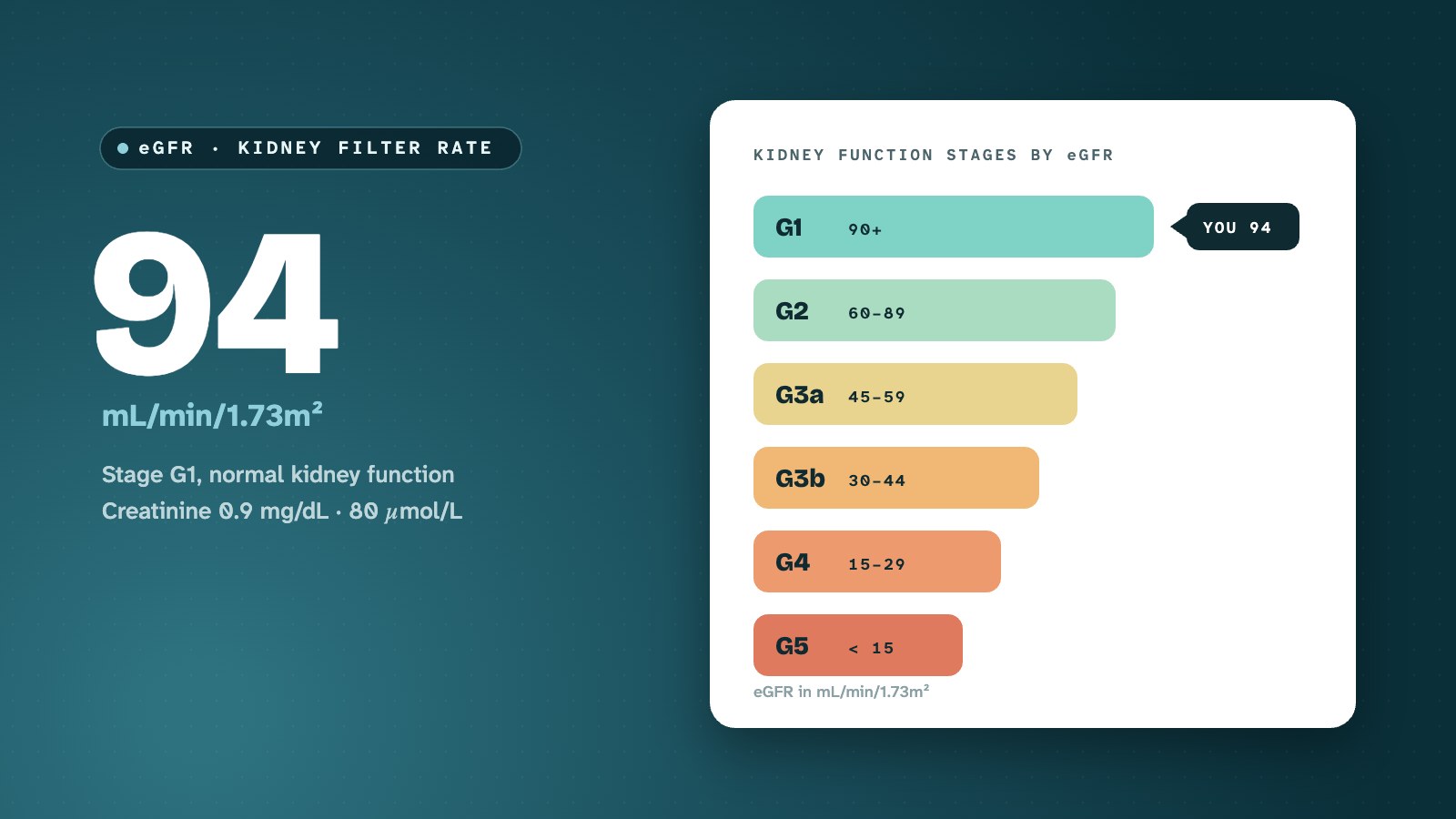
eGFR (estimated glomerular filtration rate) is calculated from your creatinine, age and sex. It’s the best everyday measure of kidney function.
| eGFR | Stage | Meaning |
|---|---|---|
| 90 and above | G1 | Normal (counts as early CKD only if there are other signs of kidney damage) |
| 60 to 89 | G2 | Mildly decreased |
| 45 to 59 | G3a | Mildly to moderately decreased |
| 30 to 44 | G3b | Moderately to severely decreased |
| 15 to 29 | G4 | Severely decreased |
| Below 15 | G5 | Kidney failure |
Chronic kidney disease (CKD) is diagnosed when eGFR stays below 60 for more than three months, or when there are other signs of kidney damage, such as albumin in the urine. A single low reading is usually repeated before any conclusion is drawn.
BUN and urea
Urea comes from the breakdown of protein. It rises when kidney function falls, but also with dehydration, a high-protein diet, bleeding in the stomach or gut, and some medicines. It falls with a low-protein diet and liver disease. Doctors read it alongside creatinine.
Uric acid
High uric acid can cause gout, a very painful joint swelling that often starts in the big toe, and kidney stones. It rises with kidney disease, alcohol (especially beer), sugary drinks, diets heavy in red meat, organ meat and shellfish, obesity, and some medicines, including some diuretics (water pills).
A mildly high uric acid without symptoms often only needs lifestyle changes. Your doctor will decide whether medicine is needed.
The urine test: the earliest warning
For people with diabetes, a urine albumin-to-creatinine ratio (UACR or ACR) can show kidney damage years before creatinine rises. Guidelines advise checking it at least once a year along with eGFR. A UACR of 30 mg/g (3 mg/mmol) or more, confirmed on repeat tests, is a sign of early kidney damage, and newer medicines can slow it down.
Who should check kidney function regularly?
- People with diabetes or high blood pressure, usually at least once a year
- People with heart disease, obesity or a family history of kidney disease
- Adults over 60
- People who take NSAID painkillers often, or medicines cleared by the kidneys, such as metformin or lithium
How to protect your kidneys
- Keep your blood sugar and blood pressure in target. This is the single most important step. Use our blood sugar chart and blood pressure chart to know your numbers.
- Take your diabetes and blood pressure medicines every day. Some of them, such as ACE inhibitors, ARBs and SGLT2 inhibitors, also protect the kidneys.
- Limit NSAIDs like ibuprofen and naproxen unless your doctor says they’re safe for you.
- Be careful with supplements and “detox” products, some of which can harm the kidneys.
- Cut down on salt: processed and restaurant food, canned soups, deli meats and salty snacks are the main sources.
- Drink enough water, unless your doctor has told you to limit fluids.
- Don’t smoke.
When to contact your doctor promptly
- A sudden rise in creatinine compared with your previous result
- Potassium above about 6.0 mmol/L
- Passing very little urine, swelling of the feet, ankles or face, shortness of breath, or severe weakness
Track your kidney results with Curevity
Kidney health is all about the trend. A creatinine of 1.2 mg/dL means something different if it was 0.9 last year. In the free Curevity app, you can scan every report with the lab report scanner, track creatinine, eGFR and uric acid over time, and ask the Curevity AI health assistant to compare your latest results with earlier ones. You can log your blood pressure and blood sugar in the same app.
Curevity doesn’t diagnose kidney disease. It keeps you organized so you can bring the full picture to your doctor.
Frequently asked questions
What is a normal creatinine level?
Usually about 0.7 to 1.3 mg/dL (60 to 110 µmol/L) in men and 0.5 to 1.1 mg/dL (45 to 90 µmol/L) in women, though each lab prints its own range.
Do I need to fast for a kidney function test?
Usually not, though some labs ask you to avoid a large meat meal beforehand. If fasting glucose or a lipid panel is drawn at the same time, you’ll need to fast for those.
Can drinking more water lower creatinine?
If you were dehydrated, drinking enough water can bring a temporarily high creatinine back down. It doesn’t fix reduced kidney function.
What does eGFR of 60 mean?
An eGFR around 60 means mildly reduced kidney function. It’s common in older adults and often stable, but your doctor will usually recheck it and test your urine for albumin.
This article is for general information and does not replace medical advice. Always discuss your results with your doctor.