
Your father takes a tablet for blood pressure in the morning, two for diabetes, and something for his cholesterol at night. Your mother has her thyroid tablet before breakfast. On the phone they say “Yes, I took it”, but you live in another city or another country, and you can’t see the pill bottles.
Missing doses of long-term medicines is very common, at every age. It is rarely about not caring. This guide covers what actually helps: one clear list, a routine that does the remembering, reminders that can’t be ignored, and a calm way for you to know a dose was missed without calling five times a day.
Why parents miss doses
Before fixing it, it helps to know which of these is happening at home. Often it is more than one.
- Too many medicines at different times. Four or five medicines, some before food and some after, is hard for anyone to keep straight.
- Forgetting on a busy or unusual day: a wedding, a hospital visit, travel, or guests at home.
- Unsure whether a dose was already taken, so they skip it to be safe, or take it twice.
- Side effects or doubts. A tablet that makes them dizzy, or a feeling that it is “not needed now that the sugar is fine”.
- The bottle ran out and the refill was not bought in time.
- Small print and similar-looking tablets, especially for parents with weak eyesight.
Start with one clear medicine list
Most problems get smaller once there is a single, correct list. Do this together, in person or on a video call:
- Collect every bottle, blister pack and the latest prescription in one place.
- For each medicine, write the name, strength (for example 500 mg), how many tablets, what time, and whether it is before or after food.
- Remove expired medicines and anything the doctor has stopped. Ask the doctor or pharmacist if you are not sure.
- Check for the same medicine under two brand names. It happens more often than you would think.
- Keep one copy at home, in large print, and one on your own phone.
Tip: take a photo of each bottle or pack next to the list. When a refill looks different because the brand changed, your parents can check the name and strength against the photo.
Make the daily routine do the remembering
Memory is unreliable; habits are not. Tie each dose to something that already happens every day.
- Link doses to fixed moments: the morning tea, lunch, the evening news, brushing teeth before bed.
- Use a weekly pill organiser with morning, afternoon and night boxes. Fill it once a week, ideally with someone checking.
- Keep medicines in one visible place, away from heat and sunlight, not hidden in different drawers.
- Put thyroid tablets by the bed if they have to be taken on an empty stomach, with a glass of water ready.
Use reminders they can’t miss
A normal phone notification is easy to swipe away without noticing. For important medicines, an alarm-style reminder that keeps ringing until it is answered works better, especially for parents who keep the phone in another room.
- Choose large text and a simple screen. Fewer buttons means fewer mistakes.
- Let them answer the reminder with one tap: taken, snooze or skip.
- Set it up together and test it once. Many reminders fail because of silent mode or battery-saving settings, not the app.
- Add the food rule to the reminder itself, so “after food” or “empty stomach” shows at the right time.
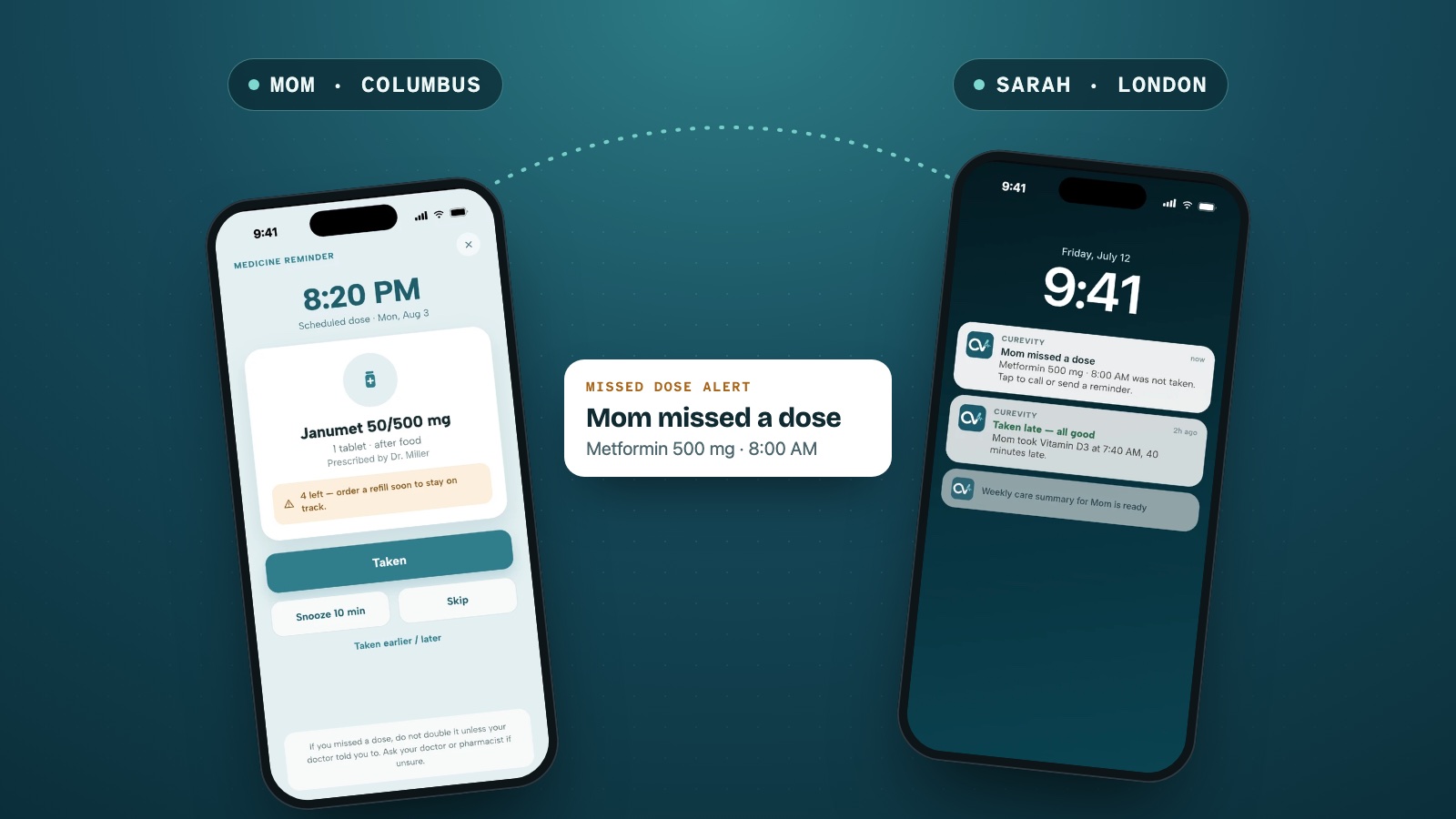
A medicine reminder app with alarm-style reminders does this for you, and counts the tablets left so you know when a refill is due.
Stay in the loop from another city or country
Daily calls to ask “Did you take your pills?” can feel like checking up on them, and both sides get tired of it. A better arrangement is quiet by default and speaks up only when something is missed.
Agree on how you will check
Talk about it openly. Most parents are happy to share whether doses were taken if it means fewer worried calls. Agree what you will see and what stays private.
Use missed-dose alerts, not constant tracking
With a caregiver app, the parent answers their own reminder and you get an alert on your phone only if a dose was not logged. If they take it late, you see that too, so you don’t panic over nothing.
Have someone nearby
Keep the number of a neighbour, a relative in the same city, or the local pharmacy that delivers. If an alert comes and your parent does not pick up, you know who can knock on the door.
Mind the time difference
If you live in another time zone, set your alerts for their time zone and agree on a time to talk when it is daytime for both of you.
Never let a refill run out
- Count what is left once a week when you fill the pill organiser.
- Reorder when about a week’s supply is left, not on the last day.
- Ask their pharmacy about home delivery or mail-order refills, and keep the prescription details on file with them.
- Before travel, pack enough for the trip plus a few extra days, in hand luggage.
Listen when they skip on purpose
Sometimes a parent stops a medicine because of a side effect, the cost, or because they feel fine. Ask without blaming. Then take the concern to their doctor, who may change the dose, the timing or the medicine.
Don’t stop or change blood pressure, diabetes, heart or thyroid medicines on your own, even when the readings look good. Good readings often mean the medicine is working. Talk to the doctor first.
If a dose is missed, do not take two together unless the doctor or pharmacist has said that is right for that medicine. Rules differ from medicine to medicine.
When to call the doctor
Call their doctor if several doses of an important medicine have been missed, or if your parent has new symptoms after starting or stopping a medicine. In an emergency, such as chest pain, trouble breathing, sudden weakness, confusion or fainting, call the local emergency number straight away.
A simple weekly checklist
| When | What to check | Who |
|---|---|---|
| Every day | Reminders answered: taken, snoozed or skipped | Parent, with alerts to you |
| Once a week | Fill the pill organiser and count what is left | Parent or helper |
| Once a week | Look at the week’s missed doses together on a call | You and your parent |
| When 7 days are left | Reorder the medicine | Whoever buys it |
| Every doctor visit | Update the medicine list, remove stopped medicines | Parent, with you on the phone |
How Curevity can help
Curevity is a free app for iPhone and Android, made for exactly this. Your parent gets alarm-style medicine reminders with large text and one-tap answers, and refill counts. You install it on your own phone, enter an invite code, and get missed-dose alerts wherever you live. Reminders and one caregiver are free, with no ads.
Want to see the numbers too? Your parent can log BP and sugar in the same app, and you can check what their readings mean with our free blood sugar chart and BP chart.