
Thyroid problems are common, especially in women and after age 60. An underactive thyroid (hypothyroidism) affects roughly 1 in 20 people at some point, and many have only mild symptoms for years. The thyroid blood test is simple, but a report full of TSH, free T4, T3 and antibody values can be confusing.
This guide explains what each value means, gives typical adult ranges in both US and UK/Canadian units, shows how doctors read the results together, and covers how to get an accurate test.
Important: thyroid ranges vary between labs and test methods, and are different in pregnancy. Always compare your result with the reference range on your own report and discuss it with your doctor.
Thyroid test normal range chart for adults
| Test | US units | UK / Canada (SI units) |
|---|---|---|
| TSH | About 0.4 to 4.0 mIU/L (some labs up to 4.5 or 5.0) | |
| Free T4 (FT4) | About 0.8 to 1.8 ng/dL | About 12 to 22 pmol/L |
| Free T3 (FT3) | About 2.3 to 4.2 pg/mL | About 3.1 to 6.8 pmol/L |
| Total T4 | About 5 to 12 µg/dL | About 65 to 155 nmol/L |
| Total T3 | About 80 to 200 ng/dL | About 1.2 to 3.1 nmol/L |
| Anti-TPO antibodies | Usually below about 35 IU/mL (varies by lab) | |
What TSH, T4 and T3 mean
- TSH (thyroid-stimulating hormone) is made by the pituitary gland in your brain. It tells the thyroid how hard to work, and it’s the best single screening test.
- T4 (thyroxine) is the main hormone the thyroid makes.
- T3 (triiodothyronine) is the more active form, mostly converted from T4 in the body.
- “Free” values measure hormone that’s available for your body to use. They’re usually more useful than “total” values, which shift with pregnancy, birth-control pills and other factors.
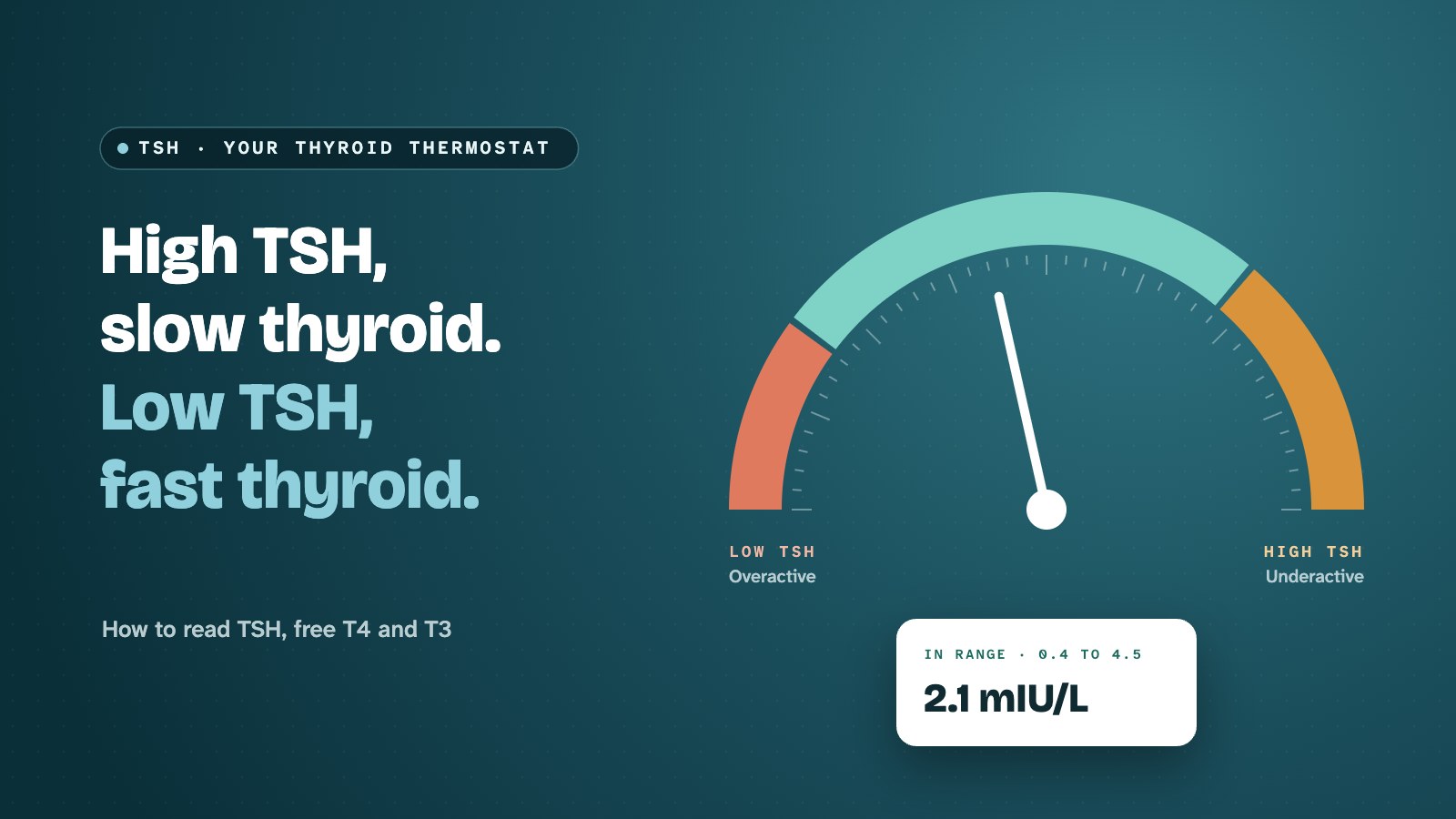
TSH works like a thermostat. When thyroid hormone is low, TSH goes up to push the thyroid harder. When thyroid hormone is high, TSH goes down. That’s why a high TSH usually means an underactive thyroid.
How doctors read the results together
| TSH | Free T4 / T3 | What it usually suggests |
|---|---|---|
| High | Low | Hypothyroidism (underactive thyroid) |
| High | Normal | Subclinical hypothyroidism (mild); usually rechecked in 6 to 12 weeks |
| Low | High | Hyperthyroidism (overactive thyroid) |
| Low | Normal | Subclinical hyperthyroidism; usually rechecked |
| Low or normal | Low | Less common; may point to a pituitary problem or severe illness |
Positive anti-TPO antibodies suggest Hashimoto’s thyroiditis, an autoimmune condition and the most common cause of hypothyroidism. TSH receptor antibodies (TRAb) point to Graves’ disease, the most common cause of hyperthyroidism.
Symptoms that may point to a thyroid problem
Underactive thyroid: tiredness, weight gain, feeling cold, dry skin, hair thinning, constipation, low mood, heavy or irregular periods, puffy face and high cholesterol.
Overactive thyroid: weight loss despite a good appetite, fast or irregular heartbeat, sweating, heat intolerance, shaky hands, anxiety, frequent bowel movements and poor sleep.
Symptoms overlap with many other conditions, so a blood test is the only way to know.
How to get an accurate thyroid test
- Same time, same lab: TSH varies a little through the day. For follow-up tests, try to have your blood drawn at a similar time, ideally in the morning.
- If you take levothyroxine (Synthroid, Levoxyl, Euthyrox and others): ask your doctor whether to take it before or after the blood draw on test day. Many prefer the sample first.
- Biotin supplements, common in hair, skin and nail products, can make thyroid results falsely high or low. Tell your doctor or lab; you may be asked to stop for a few days before testing.
- After a dose change, TSH takes about 6 to 8 weeks to settle, so testing earlier can mislead.
- Recent serious illness can temporarily change results.
Thyroid tests in pregnancy
Thyroid hormone is important for a baby’s brain development, and ranges change in each trimester. Women planning pregnancy or who are pregnant are often tested early, and those already on levothyroxine usually need a higher dose as soon as pregnancy is confirmed. Follow your obstetrician’s or midwife’s advice closely.
Taking levothyroxine the right way
- Take it on an empty stomach, usually first thing in the morning with a full glass of water.
- Wait 30 to 60 minutes before coffee or breakfast.
- Keep about 4 hours between levothyroxine and calcium, iron or antacid tablets, which reduce absorption.
- Take it every day. Don’t stop or change the dose on your own, even if you feel fine.
A daily alarm by the bed helps. A medicine reminder app can ring every morning with an “empty stomach” note and warn you before your prescription runs out.
Keep all your thyroid results in one place
Thyroid treatment is about fine-tuning your dose over months and years, so the trend in your TSH matters. With the free Curevity app, scan each report with the lab report scanner, see your TSH values over time on one chart, and ask the Curevity AI health assistant to compare your latest result with the previous one before your appointment.
Curevity doesn’t diagnose or change doses. Your doctor decides your treatment; the app helps you keep track.
Frequently asked questions
What is a normal TSH level?
For most adults, about 0.4 to 4.0 mIU/L, though each lab prints its own range. Older adults may run slightly higher, and pregnancy uses different targets.
Do I need to fast for a thyroid test?
Usually not. But if fasting tests like glucose or a lipid panel are drawn at the same time, you’ll need to fast for those.
Does a high TSH mean hypothyroidism?
Usually, especially if free T4 is low. A mildly high TSH with a normal free T4 is called subclinical hypothyroidism, and doctors often repeat the test before deciding on treatment.
Can thyroid problems cause weight gain?
An underactive thyroid can cause modest weight gain, much of it fluid, which usually improves with treatment. It’s rarely the only reason for large weight gain.
This article is for general information and does not replace medical advice. Always discuss your results with your doctor.