
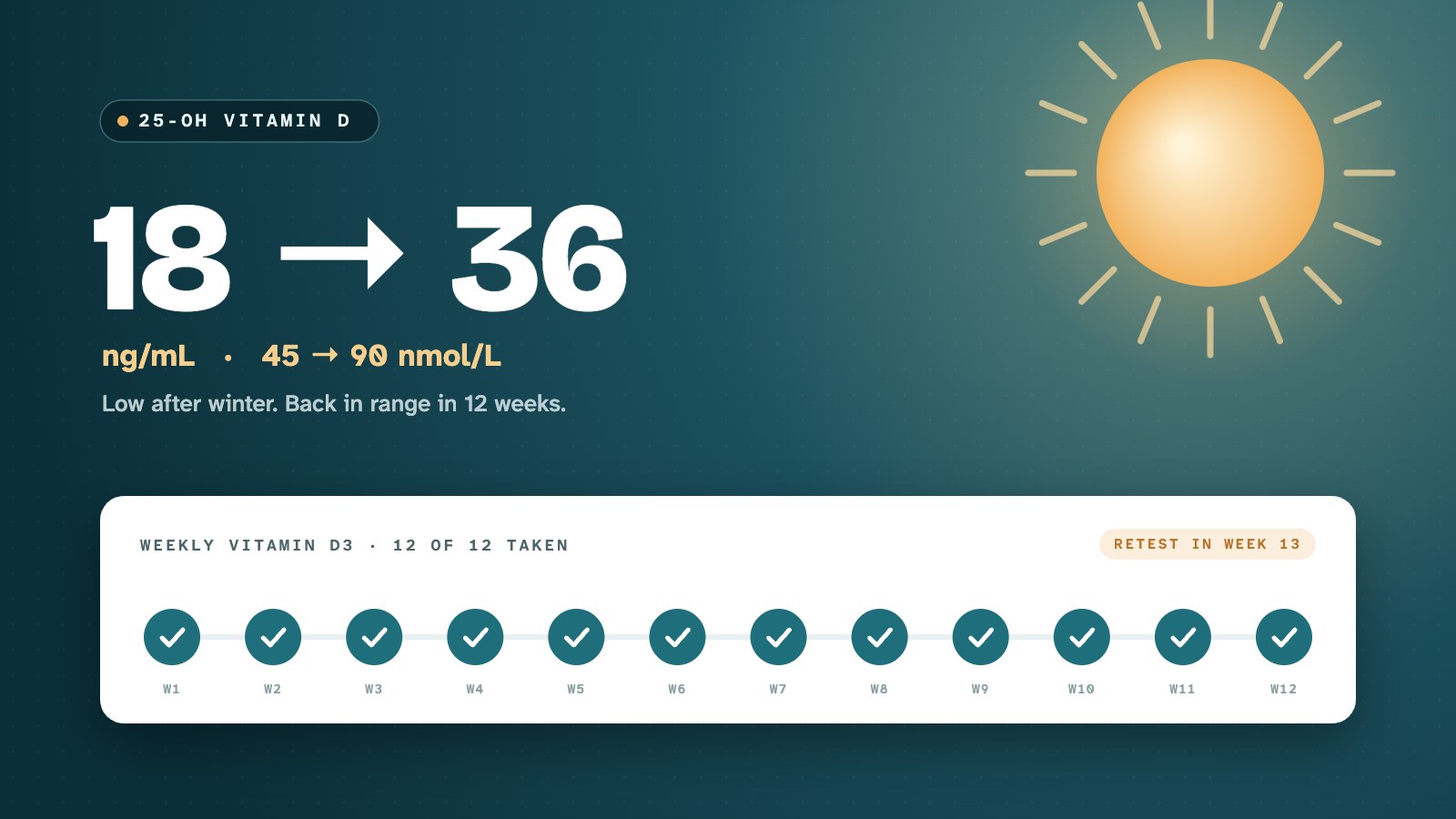
Low vitamin D is one of the most common findings on routine blood work in the US, Canada and the UK. Your skin makes vitamin D from sunlight, but at northern latitudes the sun is too weak from roughly October to March to make much at all. Add long indoor working days and sunscreen, and it’s no surprise that many people run low, especially by the end of winter.
This guide explains the vitamin D blood test, what your number means, why different labs and countries use different cut-offs, and what doctors commonly do about a low result.
Which test measures vitamin D?
The standard test is 25-hydroxy vitamin D, written as 25(OH)D. It reflects the vitamin D your body has from sunlight, food and supplements over the past few weeks. No fasting is needed.
A different test, 1,25-dihydroxy vitamin D, is not used to check for deficiency and is only ordered in special situations, such as kidney disease or calcium disorders.
Vitamin D levels chart
US labs usually report in ng/mL; UK, Canadian and European labs use nmol/L. Multiply ng/mL by 2.5 to get nmol/L.
| Level | ng/mL | nmol/L | What it usually means |
|---|---|---|---|
| Deficient | Below 12 | Below 30 (UK: below 25) | Risk of bone problems; treatment usually recommended |
| Inadequate for some people | 12 to 20 | 30 to 50 | May be too low for bone health in some people |
| Adequate for most people | 20 and above | 50 and above | Enough for bone health in nearly everyone (US National Academies, UK guidance) |
| Many labs’ “optimal” range | 30 to 100 | 75 to 250 | Used by many US labs, based on older Endocrine Society advice |
| Possibly too high | Above 50 to 100 | Above 125 to 250 | Usually from high-dose supplements; can raise blood calcium |
This is why the same result can be flagged “low” on one report and “normal” on another. A level of 25 ng/mL (62 nmol/L), for example, is adequate by US National Academies and UK standards but marked “insufficient” by labs using a 30 ng/mL cut-off. Your doctor will interpret it for you.
Symptoms of low vitamin D
Many people with low vitamin D feel completely normal. When symptoms appear, they can include:
- Tiredness and low energy
- Aching bones, especially in the lower back, hips and legs
- Muscle weakness or cramps
- Low mood, particularly in winter
- In long-standing deficiency, soft bones (osteomalacia in adults, rickets in children) and a higher risk of fractures
These symptoms have many other causes, so a blood test is needed to know.
Who is more likely to be low?
- Anyone living at northern latitudes in late winter and spring
- People who spend most of the day indoors, are housebound or live in care homes
- People with darker skin, who need more sun to make the same amount of vitamin D
- Adults over 65, whose skin makes less vitamin D
- People with obesity
- Pregnant and breastfeeding women, and breastfed babies
- People who cover most of their skin outdoors
- People with Crohn’s disease, celiac disease, kidney or liver disease, or after weight-loss surgery
- People on some medicines, such as certain anti-seizure drugs and long-term steroids
How much vitamin D do you need?
- US and Canada: the recommended intake is 600 IU (15 mcg) a day for adults up to 70, and 800 IU (20 mcg) over 70.
- UK: the NHS advises everyone to consider a daily supplement of 10 micrograms (400 IU) in autumn and winter, and all year round for people who get little sun.
- Upper limit: for adults, 4,000 IU (100 mcg) a day unless a doctor prescribes more.
How low vitamin D is usually treated
Treatment depends on your level, age and health, so follow your doctor’s advice. Commonly:
- A higher “loading” course of vitamin D3 (cholecalciferol) for several weeks, given daily or weekly, followed by a lower maintenance dose.
- Calcium, sometimes, especially for older adults and people with osteoporosis.
- A repeat test after about 3 months to check the level has come up.
Don’t take high-dose vitamin D for months without medical advice. Too much can raise calcium in your blood and harm your kidneys. More isn’t better.
Weekly and monthly doses are easy to forget. A medicine reminder that can repeat “every 7 days” or on a set weekday makes sure you finish the course.
Getting vitamin D naturally
- Sunlight: from late spring to early autumn, short periods of sun on your forearms and lower legs, without sunscreen, a few times a week helps most people. Never let your skin burn.
- Food: oily fish (salmon, mackerel, sardines, herring), egg yolks, and fortified foods such as milk, plant milks, some breakfast cereals and spreads. UV-exposed mushrooms also contain some vitamin D.
- Staying active outdoors also helps your bones and muscles.
Food alone rarely corrects a true deficiency, which is why doctors usually start with a supplement.
Track your vitamin D and other results with Curevity
Vitamin D, B12, glucose, cholesterol and thyroid results often arrive on the same lab report. In the free Curevity app for iPhone and Android, you can scan the whole report with the lab report scanner, see each value with its range, and track your vitamin D over time after treatment. You can also ask the Curevity AI health assistant to explain your latest report in plain English and prepare questions for your doctor.
Curevity doesn’t diagnose or prescribe. It keeps your health data organized, encrypted on your own phone.
Frequently asked questions
What is a normal vitamin D level?
Most experts consider 20 ng/mL (50 nmol/L) or above adequate for bone health. Many US labs use 30 to 100 ng/mL (75 to 250 nmol/L) as their reference range. Your doctor will tell you what target applies to you.
Do I need to fast for a vitamin D test?
No. The 25-hydroxy vitamin D test can be done at any time without fasting.
How long does it take to raise vitamin D levels?
With a supplement prescribed by your doctor, levels usually rise over 6 to 12 weeks. Your doctor will decide when to retest.
Can vitamin D be too high?
Yes. Very high levels, almost always from taking large doses for too long, can raise blood calcium and cause nausea, confusion and kidney problems. Take supplements only as advised.
This article is for general information and does not replace medical advice. Always discuss your results and any supplements with your doctor.