
A lipid panel (also called a lipid profile or cholesterol test) measures the fats in your blood that affect your risk of heart attack and stroke. In the US, adults are usually advised to have one every few years from their twenties or thirties; in the UK, it’s part of the NHS Health Check from age 40. People with diabetes, high blood pressure or heart disease are tested more often.
Your report shows four or five numbers: total cholesterol, LDL, HDL, triglycerides and often non-HDL cholesterol or a ratio. This guide explains what each one means, gives typical targets in both US units (mg/dL) and UK/Canadian units (mmol/L), and covers how to prepare.
Important: the targets below are general guidance for adults. If you have diabetes, heart disease, kidney disease or a strong family history, your doctor will likely set a lower personal target, especially for LDL. Always follow your own doctor’s target.
Lipid panel normal values chart
| Test | Desirable (mg/dL) | Desirable (mmol/L) | High |
|---|---|---|---|
| Total cholesterol | Below 200 | Below 5.2 (NHS: 5 or below) | 240+ mg/dL (6.2+ mmol/L) |
| LDL (“bad”) cholesterol | Below 100 (optimal) | Below 2.6 (NHS: 3 or below) | 160+ mg/dL (4.1+ mmol/L); 190+ is very high |
| HDL (“good”) cholesterol | 60+ is protective | 1.0+ for men, 1.2+ for women | Low: below 40 mg/dL in men, below 50 in women |
| Non-HDL cholesterol | Below 130 | Below 3.4 (NHS: 4 or below) | 190+ mg/dL (4.9+ mmol/L) |
| Triglycerides | Below 150 | Below 1.7 (fasting) | 200+ mg/dL (2.3+ mmol/L); 500+ is very high |
| Total cholesterol / HDL ratio | Below 5; ideally below 3.5 to 4 | 5 or above | |
To convert cholesterol from mg/dL to mmol/L, divide by 38.67. For triglycerides, divide by 88.57.
What each number means
Total cholesterol
The sum of all the cholesterol in your blood. It’s a useful first look, but on its own it can mislead: a high total with a high HDL may be fine, while a “normal” total with low HDL and high LDL may not be. Your doctor looks at the breakdown.
LDL cholesterol: the main target
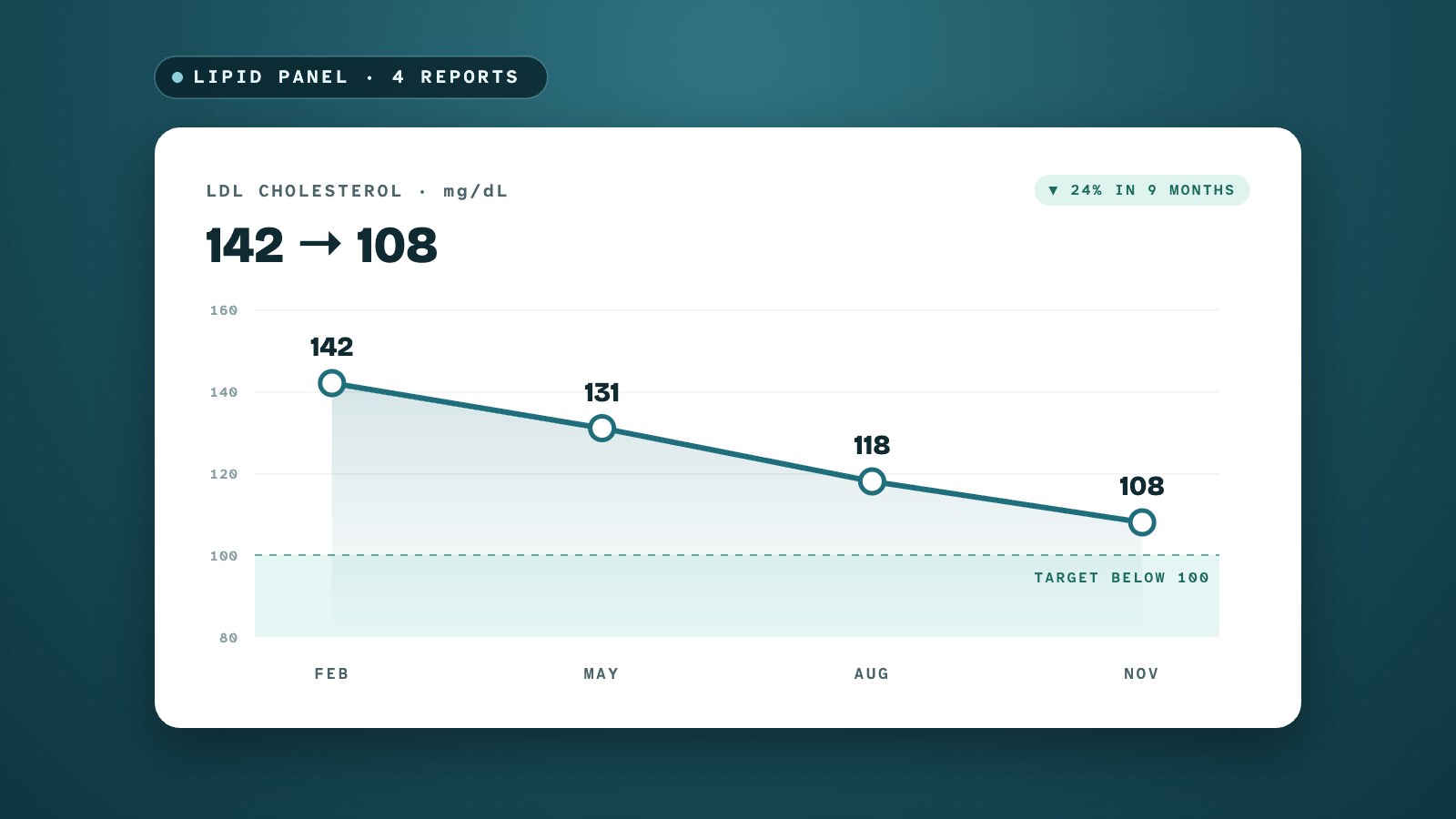
LDL carries cholesterol into the walls of your arteries, where it can build up as plaque. That’s why it’s called “bad” cholesterol, and why most treatment decisions are based on it. The lower your LDL, the lower your risk, especially if you already have diabetes or heart disease. Many people with heart disease are given targets below 70 mg/dL (1.8 mmol/L) or even 55 mg/dL (1.4 mmol/L).
HDL cholesterol: the “good” one
HDL carries cholesterol away from your arteries back to the liver. Higher is generally better. Low HDL often goes with belly fat, type 2 diabetes, smoking and inactivity.
Non-HDL cholesterol
Total cholesterol minus HDL. It includes every type of cholesterol that can harm your arteries, so many doctors (and NHS guidance) now use it alongside or instead of LDL, especially when triglycerides are high.
Triglycerides
A type of fat that rises with sugar, refined carbohydrates, alcohol and excess weight. High triglycerides often go with low HDL and type 2 diabetes. Very high levels (above 500 mg/dL or 5.6 mmol/L) can cause pancreatitis and need prompt treatment.
How to prepare for a lipid panel
- Fasting: many doctors now accept a non-fasting test. If your triglycerides were high before, or your lab asks for it, fast for 9 to 12 hours, drinking only water.
- Skip alcohol and very heavy, fatty meals the day before.
- Take your usual medicines unless your doctor says otherwise.
- Recent illness, surgery or a heart attack can temporarily change your numbers; your doctor may repeat the test later.
What causes high cholesterol?
- Genes, including familial hypercholesterolemia, where LDL is very high from a young age (about 1 in 250 people)
- A diet high in saturated fat (fatty red and processed meat, butter, cheese, pastries) and trans fats
- Excess weight, especially around the waist
- Physical inactivity
- Type 2 diabetes, an underactive thyroid, kidney disease and some medicines
- Smoking, which also lowers HDL
An underactive thyroid can raise LDL, so doctors often check TSH when cholesterol is high. See our thyroid test guide.
Everyday steps that help
- Choose more fiber: oats, barley, beans, lentils, vegetables, fruit and whole grains. Soluble fiber directly lowers LDL.
- Swap saturated fats for unsaturated ones: olive or canola oil, nuts, seeds, avocado and oily fish.
- Cut back on processed meats, fried food, pastries, sugary drinks and refined carbs.
- Move for at least 150 minutes a week, such as a brisk 30-minute walk five days a week.
- Lose 5 to 10% of your weight if you’re overweight. It lowers triglycerides noticeably.
- Stop smoking and keep alcohol within recommended limits.
Many people also need a statin or another medicine, depending on their overall risk. Don’t stop a cholesterol medicine on your own because your next result looks good. A good result usually means the medicine is working.
Track your cholesterol over time with Curevity
Keeping every report in one place shows whether your LDL and triglycerides are really coming down. In the free Curevity app, you can scan a lab report photo or PDF with the lab report scanner, see your LDL, HDL and triglyceride trend on a chart, and ask the AI health assistant to compare your latest report with the last one. The AI diet plan can build a 7-day meal plan around your readings and food preferences.
Curevity doesn’t diagnose or replace your doctor. It keeps your numbers organized so you arrive at your next appointment with good questions.
Frequently asked questions
What is a normal LDL level?
For most adults, below 100 mg/dL (2.6 mmol/L) is optimal. NHS guidance uses 3 mmol/L or below as healthy for the general population. People with diabetes or heart disease are usually given lower targets by their doctor.
Do I need to fast for a cholesterol test?
Often not. Non-fasting tests are widely accepted, but your doctor may ask you to fast for 9 to 12 hours if your triglycerides were high before.
Can thin people have high cholesterol?
Yes. Genes play a big role, so people of normal weight can have high LDL. A blood test is the only way to know.
Which matters more, LDL or HDL?
Doctors mainly treat LDL and non-HDL cholesterol. Raising HDL with medicines hasn’t been shown to prevent heart attacks, but the healthy habits that raise HDL are still good for you.
This article is for general information and does not replace medical advice. Always discuss your results and targets with your doctor.